

Case Study
Incident and Allegations
What lighting conditions are necessary to traverse a parking lot at night? What does science say about obstacle detection and avoidance when walking?
When walking through a parking lot after exiting a building at night, an individual allegedly tripped and fell, resulting in injuries. They claimed that the area was “pitch black” and that they were unable to detect a wheel stop near the curb. When they stepped off a curb, they tripped over the wheel stop and fell. It was alleged that the property/parking lot owner failed to provide sufficient lighting at the location of the incident.
S-E-A was retained by the property/parking lot owner to evaluate the lighting conditions and their role in the incident. Additionally, S-E-A was requested to perform a human factors analysis, to evaluate the plaintiff’s perception reaction time, decision making, and other factors unique to the individual and claim.
Investigation & Analysis
S-E-A documented the site and took measurements of the curb and the parking lot, including wheel stop dimensions and positions. The property/parking lot’s design plans were also reviewed to identify lighting installations and overall geometry of the scene. Using an illuminance meter (light meter) on a date where weather conditions closely resembled that of the incident date, S-E-A collected light measurements from the scene representative of the time and conditions of the incident.
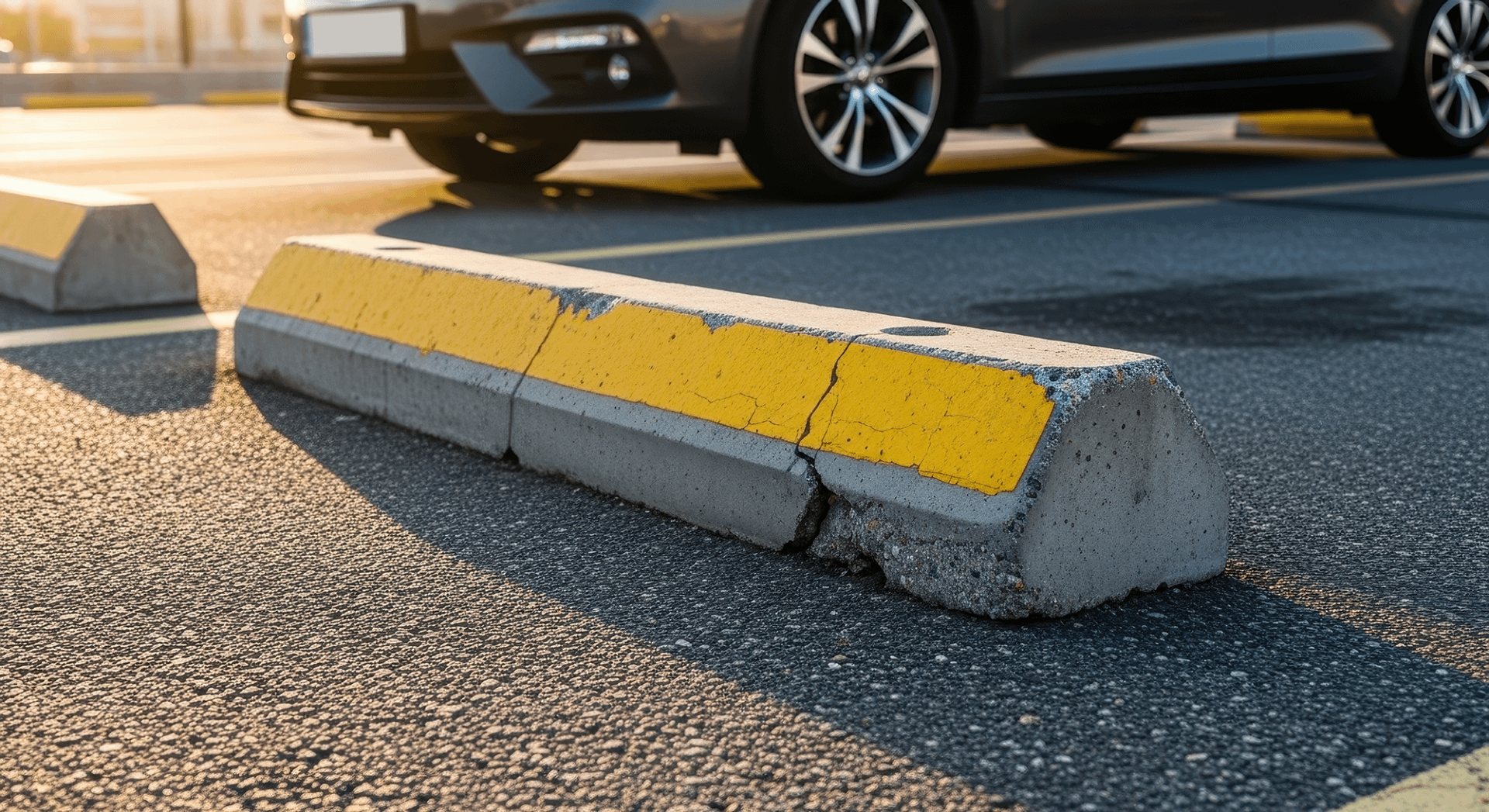
Example of wheel stop parking lot setup
Analysis of the Human Factors considerations showed three criteria to evaluate the claims:
- The minimum toe clearance (MTC), defined as the vertical distance between the toe and the ground during the swing phase of walking, was identified for individuals in the plaintiff’s age group. This measurement is important because it establishes the threshold height at which an obstacle can present a tripping hazard. The amount of lighting needed to detect obstacles of varying heights corresponding to the MTC with a 95% likelihood was identified, accounting for variations in these values for young and old age groups.
- The incident scene was reconstructed and the lighting available for the plaintiff at the time of the incident was quantified in lux, a unit of illumination. These measurements considered the potential shadowing effects of nearby parked cars. Since testimonies about nearby cars were inconsistent across witnesses, S-E-A evaluated the conditions with different car sizes, parking configurations, and parking angles to assess the effect of shadows. An example is shown below.
- Lastly, the claimant’s attention and situation awareness at the time of the incident were also evaluated. S-E-A considered scientific studies on gaze behavior while walking and research on human behavior in low illumination environments, which the plaintiff alleged were present in this case.
Evidence was evaluated resulting in the following findings, among others:
S-E-A found that the parking lot and its light fixtures did not meet the design plan approved and permitted by the municipality. However, it was also determined that the lighting at the time of the incident was sufficient for detecting obstacles at the MTC for individuals in the plaintiff’s age group, and, importantly, for detecting objects as small as one tenth the height of the subject wheel stop. Moreover, the plaintiff testified to being unaware of the other wheel stops closer to a light source that were more brightly lit than the subject wheel stop. These combined findings suggest that the lighting at the time of the incident was sufficient to allow the wheel stops to be detected by an attentive pedestrian.
Further, had the location been as dark as alleged (the plaintiff claimed it was “pitch-black”), research shows that the plaintiff’s behavior would likely have differed from what was reported. For example, under such conditions, a person would typically adjust their walking gait, turn back and choose an alternate route, or use the cell phone in their hand as an additional light source. This analysis indicates that either the plaintiff’s claim regarding the lighting condition was inconsistent with the actual condition at the time, or the plaintiff’s actions were inconsistent with the reasonable behaviors typically observed when navigating in very low-light environments.