


Michael Vigorita, Mechanical Engineer
S-E-A Baltimore
Power tools are designed with layers of safety built in, including guards, brakes, warnings, and detailed instructions. Yet serious injuries still occur, often because these protections are overlooked, bypassed, or misunderstood.
S-E-A was tasked with an evaluation of a chain saw incident with a fact pattern familiar to the industry. An experienced handyman was using a chainsaw during routine work when a severe leg injury occurred.
Is the Product the Problem?
At first glance, the situation raised concerns whether the tool had malfunctioned or if a design defect contributed to the outcome. S-E-A’s investigation analyzed the design, functionality and use of the tool at the time of the incident to determine what factors contributed to or caused the incident. Specifically, this included:
- Inspecting and documenting the chainsaw and incident scene with measurements, photographs, and 3D laser scans.
- Assessing the personal protective equipment (PPE), training, warnings/labels, and safety protocols.
- Evaluating the medical evidence to determine the possible scenarios that could result in the subject injury.
Through that detailed analysis, it became clear that the tool itself was not the primary issue. Instead, the injury resulted from a combination of missed safeguards and decision-making factors that, together, created the conditions for the incident.
Most critically, the chainsaw was designed and equipped with a functioning chain brake. This feature is a critical safety design required by both the Occupational Safety and Health Administration (OSHA) and the American National Standards Institute (ANSI) and is intended to stop the chain during kickback or loss of control. However, the investigation revealed that it was not engaged at the time of the incident. Under proper use, this feature likely would have prevented the injury altogether.
The Hidden Risk: Layered Failures
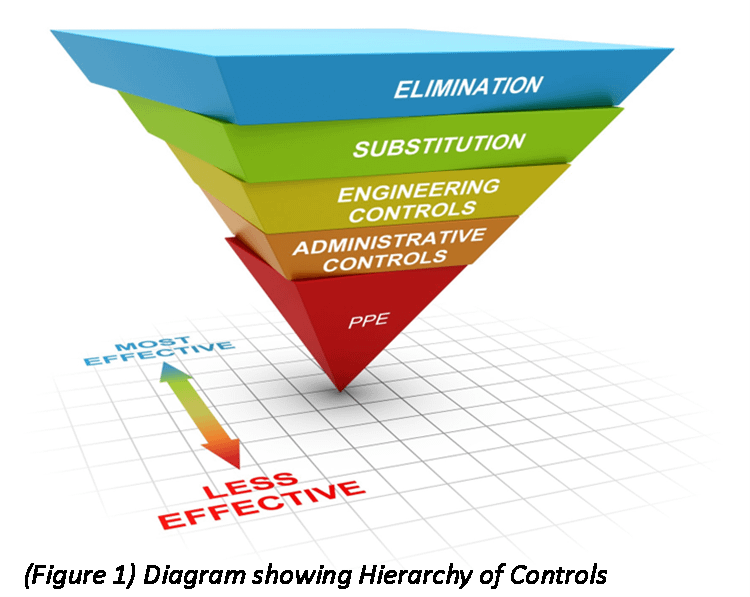
What makes incidents like this so instructive is not a single point of failure, but the alignment of several simultaneous failures. OSHA outlines the Hierarchy of Controls (see Figure 1) as a general approach for safeguarding hazards that exist in a design. Other than elimination, which is often hard to accomplish, controls are meant to reduce either the probability of hazard exposure or the severity of the hazard, but rarely remove the hazard entirely. In the case of the chainsaw, the tool’s whole purpose is to spin a chain to cut, so the hazard of the spinning chain cannot be eliminated or substituted.
Rather, other controls like the chain brake (an engineering control), training and procedures (administrative controls), and PPE are utilized to reduce the hazard to an acceptable level. Therefore, the combination of safeguards is what makes the product fit for use, and overriding or ignoring any of them can result in injury or increase the severity of the injury.
In this case, training and procedural adherence also played a role in causing the chain saw incident. These administrative controls are used to reduce the probability of occurrence, usually in conjunction with engineering safeguards like the chain brake feature. S-E-A gathered data that showed the chainsaw instructions and warnings associated with the tool were not followed, and the operator lacked sufficient task-specific training. Although the user was an experienced handyman, experience alone did not mitigate risk, highlighting a common gap between familiarity and proper use.
Additionally, the investigation uncovered that PPE was not used during the incident. While normally the last control used to mitigate risk, higher level controls aren’t always feasible, so PPE is added to reduce the risk even more. The removal of PPE increases the severity of the hazard, which was the resulting injury. If used, the PPE would have reduced the severity of the injury.
Finally, compounding these factors was a more fundamental issue: the tool itself was not the right choice for the task. Even when functioning as designed, using an inappropriate tool introduces avoidable hazards.
The Value of Comprehensive Investigation
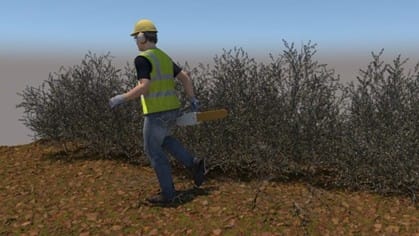
What ultimately brings clarity to these situations is the depth of analysis. In this case, investigators employed a combination of site documentation, biomechanical assessment, and scenario modeling to reconstruct the sequence of events in addition to the design and safeguarding analyses. The findings were presented to the jury, along with a 3D simulation of the incident used in a demonstrative (Figures 2 and 3).
(Figure 2) 3D model of accident site, including the worker depicted with proper PPE, chainsaw and the environment, to demonstrate causative scenario to jury how proper PPE could have helped avoid injury altogether.
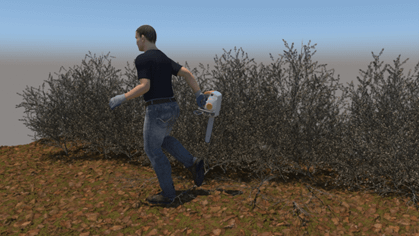
(Figure 3) 3D model of accident site, including the worker without PPE, chainsaw and the environment.
This approach moves beyond surface-level conclusions and answers a more meaningful question: not just what happened, but why it happened the way it did.
For forensic investigations, that distinction is critical. Because risk reduction responsibility is shared between the user, manufacturer, and employer, why an incident occurs can assist in determining who was not doing their part in reducing the existing risks.
How to Know if the Product is the Problem?
Perhaps the most important conclusion from the investigation was that the chainsaw met all applicable industry standards and was considered reasonably safe for its intended use.
This finding is paramount.
In many incidents, attention quickly turns to product design or manufacturing defects. But as this case demonstrates, adherence with standards does not eliminate risk when tools are misused or safeguards are overridden.
That also means that simply the existence of an incident like the chainsaw is not enough data to say whether a product is reasonably safe. An in-depth analysis is required to investigate the tool’s intended design, product materials, safety standards, used condition, operator’s experience, and injury mechanics refute or validate any alleged claims against the product. S-E-A’s experience in design, testing, and evaluation of products like power tools makes it a valuable partner in investigating incidents with alleged product malfunction or defects and can help find the truth of the incident using facts, data, and science.
