

Vehicle & Product Solutions
Tilt Table
How can a particular collision mode be evaluated in a controlled and repeatable environment? Can the difference in occupant restraint provided by three types of occupant protection systems be evaluated in a reliable and cost-effective manner?
At S-E-A the short answer to these, and many questions like this, is YES - absolutely.
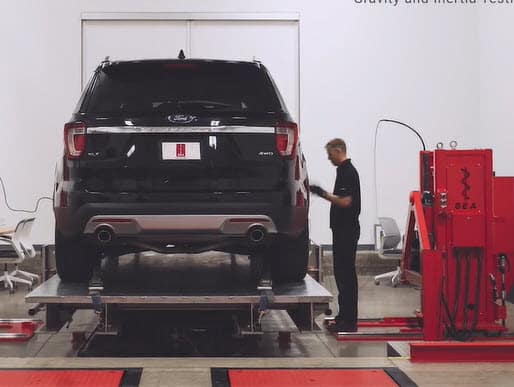
Tilt tables can be used to perform evaluations of vehicle components, such as parking brakes and mechanisms, as well as for lateral and longitudinal stability factors.
The S-E-A tilt table can use a single mounting for several tests and rotated in 90-degree increments, reducing test time dramatically.
- Longitudinal tilts (the forward and rearward tilts)
- Lateral tilts (left-side and right-side leading tilts)
- Maximum tilt angles up to 60 degrees
- Maximum test load of 5,000 lbs.
The important factors involved in accurate tilt table testing include having a rigid and flat platform; having the ability to produce slow, smooth and consistent tilt rates; and having accurate and repeatable measures of tilt angle and point of wheel lift. The SEA tilt table platform is very rigid, and it was designed to have deflections of less than 0.1 inch. It is also very flat, with a flatness tolerance of ± 0.1 inch. The hydraulic cylinder used to tilt the platform is controlled to provide for smooth tilting at rates as slow as 0.1 deg/sec. A high friction surface has been added to selected surfaces.
Tilt Tables can Be Used to Evaluate Vehicles Against:
- ANSI ROHVA 1-2023 (Section 7 – Parking Brake, Section 8 – Lateral Stability, Section 9 – Pitch Stability, and Hang Tag Angle)-Applies to off-road vehicles, called Side-by-Sides or Recreational Off-Highway Vehicles (ROVs)
- ANSI SVIA 1-2023 (Section 8 – Parking Brake)
- Applies to All-Terrain Vehicles (ATVs)
- SAE J2258 – 2022 (Section 7.8.2 – Lateral Stability Test, Section 7.9.3 – Longitudinal Stability Tests, Section 7.9.2 Parking Brake)
- Applies to Light Utility Vehicles – vehicles with maximum speed of 25 mph
- SAE J2358 – 2022 (Section 6.6.4.1 – Longitudinal Stability, Section 6.6.4.2 – Lateral Stability, Section 6.6.6.2 – Parking Brake)
- Applies to Low Speed Vehicles – vehicles with maximum speed of 20 – 25 mph
- ANSI OPEI Z135 - 2020 (Section 8.8.3 – Static Stability, Section 8.8.4.4 – Parking Brake)
- Applies to Personal Transport Vehicles (PTVs) – vehicle with maximum speed of < 20 mph
- ANSI OPEI Z130 - 2020 (Section 8.6.3 – Static Stability, Section 8.6.4.4 – Parking Brake)
- Applies to Golf Cars
- ANSI OPEI B71.9 – 2016 (Section 8.5 – Parking Brake, Section 8.6 – Tilt Table Stability)
- Applies to Multipurpose Off-Highway Utility Vehicles (MOHUVs)
- ANSI OPEI B71.1 – 2017 (Section 21.2.2 – Static Stability Tests, Section 21.3.3 – Parking Brake System)
- Applies to Ride-On Mowers
- Other internal or external engineering standards for brakes, tie-down loading, tilt table angle, or other metrics
RELEVANT PAPERS
CPSC: Tilt Table Measurements on Twenty-Two Recreational Off-Highway Vehicles for CPSC by SEA Ltd.
CPSC: SEA Report to CPSC "Vehicle Characteristics Measurements of All-Terrain Vehicles"
CPSC: Vehicle Characteristics Measurements Of Recreational Off-Highway Vehicles for CPSC by SEA Ltd.