

Case Study
Incident
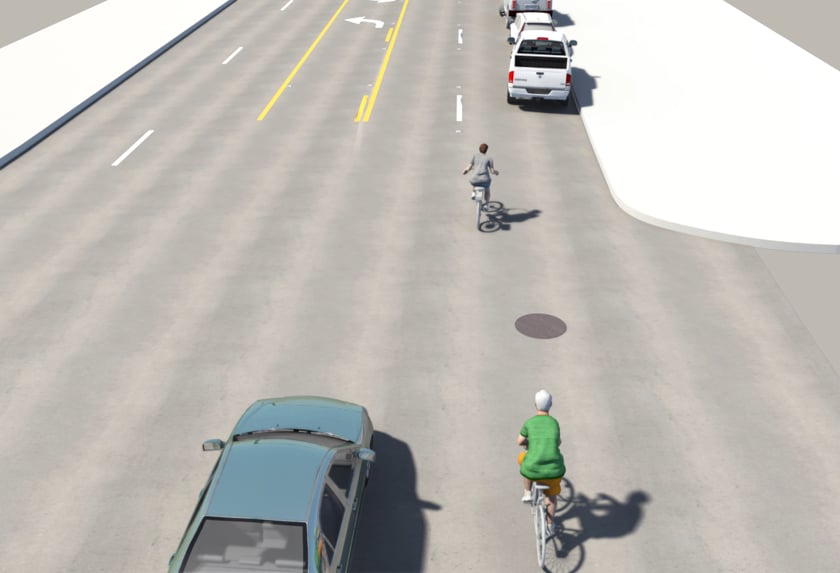
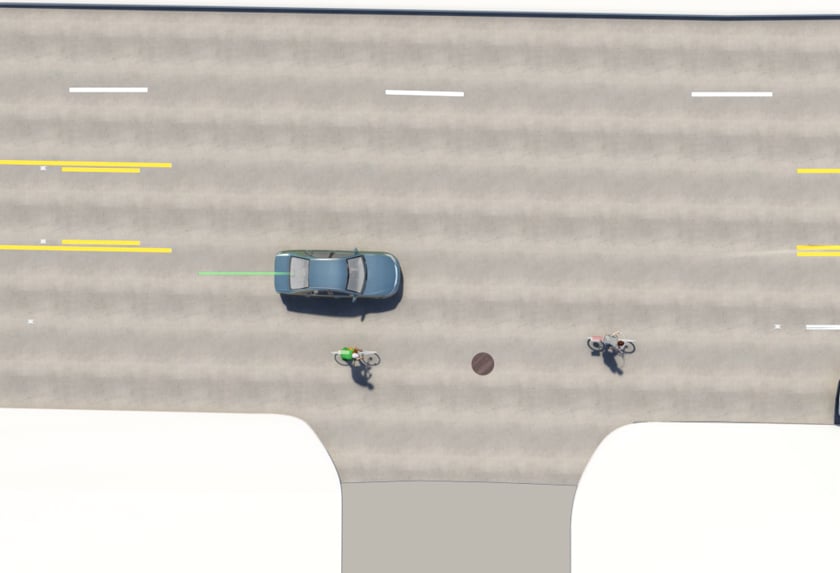
A couple, out for a bike ride on their recently purchased e-bikes, is involved in an incident that was captured by on-board cameras of two city buses. Despite having video footage from many cameras, the actual incident was not captured. Questions arose regarding the contributions of various roadway users, as well as how one of the e-bike riders sustained her injuries. S-E-A was retained to determine what happened and the contributions of the parties involved.
Was this incident the result of actions by the driver of one of the city buses in the adjacent lane, the driver of the automobile trying to park, the riding practices of the cyclists, an improperly fitted e-bike, or something else altogether? Would the use of a helmet have made a difference in the injury outcome?
Assigned Task:
S-E-A was originally asked to conduct an investigation to determine the cause(s) of and contributions to the incident. As evidence became available, S-E-A was also asked to complete a multidisciplinary analysis of the incident, including biomechanics and human factors aspects.
To perform the analysis, S-E-A took the following steps:
-
- The subject vehicles, e-bikes, and the incident site were inspected and documented with measurements, photographs, videos, and 3D laser scans.
- The specifications and manuals of the e-bikes were reviewed.
- The medical evidence, including imaging studies, was evaluated as well as scenarios that could result in the subject injuries.
- Accurate 3D models of the buses, the automobiles, the e-bikes, cyclist surrogates, and the environment were created to demonstrate the causative scenario to the jury, as well as demonstrate how there was much more to be “seen” from the missing moments in time than anyone expected.
Analysis:
- Worked with Imaging Sciences to produce a camera match of the available footage to obtain important information, like speed, timing, and distance data.
- Utilized accident reconstruction methodologies to determine relevant vehicle dynamics and the availability of perception reaction time.
- Conducted a biomechanical analysis based on the available evidence and provided medical records to determine the mechanisms of the sustained injuries.
- Applied biomechanical techniques to perform anthropomorphic and strength analyses relative to the appropriateness of the riders with their e-bikes.
- Considered alternative scenarios relative to the available physical and testimonial evidence.
Evidence was evaluated resulting in the following findings, among others:
- The wife was riding an e-bike that was too big for her; it was not properly sized for her anthropometry.
- Because of the improper e-bike sizing, she was unable to effectively control the e-bike during the accident sequence.
- When the automobile began its maneuver, the cyclists were far enough away to allow for ample time and distance to perceive and react while maintaining control of their e-bikes.
- Similarly, the cyclists were far enough behind to not be considered a potential hazard to the driver of the automobile.
- Neither bus played any role in contributing to the event.
- The husband attempted to pass the wife on her left and, in doing so, his e-bike contacted her e-bike as he moved back to the right, likely resulting in her fall.
- The biomechanical evidence was not consistent with proposed alterative scenarios.
- The lack of helmet use directly contributed to the wife’s injuries.