

Case Study
Tractor-Trailer Sideswipe
A semi-truck towing a flatbed trailer attempted to make a left turn. Before doing so, the driver veered his vehicle to the right to be able to clear the barrier on the left side of the left lane. At some point during the turn, the trailer came into contact with the right side of an SUV in the left turn lane. Mild damage was observed to both the trailer and passenger vehicle before each was driven away from the scene. The plaintiff in the SUV later claimed significant cervical and lumbar injuries as a result of the incident.
S-E-A was asked to reconstruct the accident and analyze the biomechanical exposure to injury for a person in the SUV during the subject incident. Through a series of virtual and physical reconstruction studies, S-E-A was able to perform a full-scale crash test where the resulting damage to the SUV closely resembled that on the subject SUV.
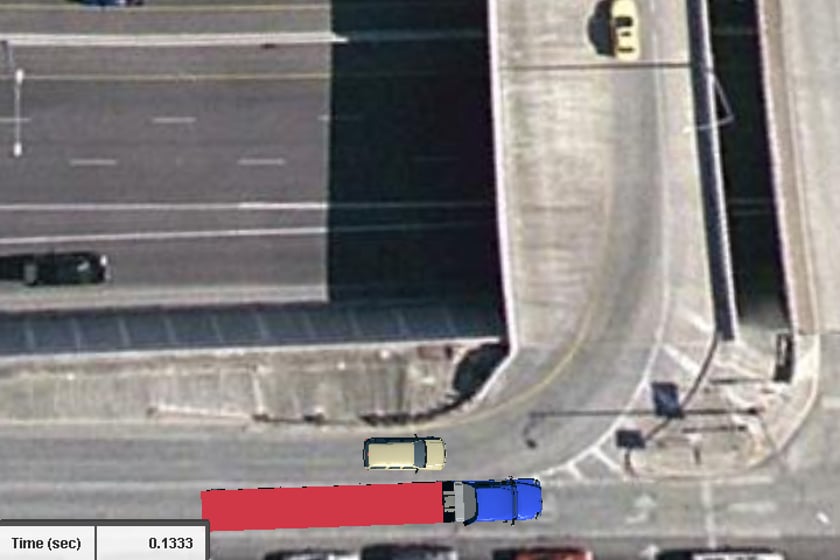
S-E-A Human Vehicle Environment (HVE) recreation of accident scenario
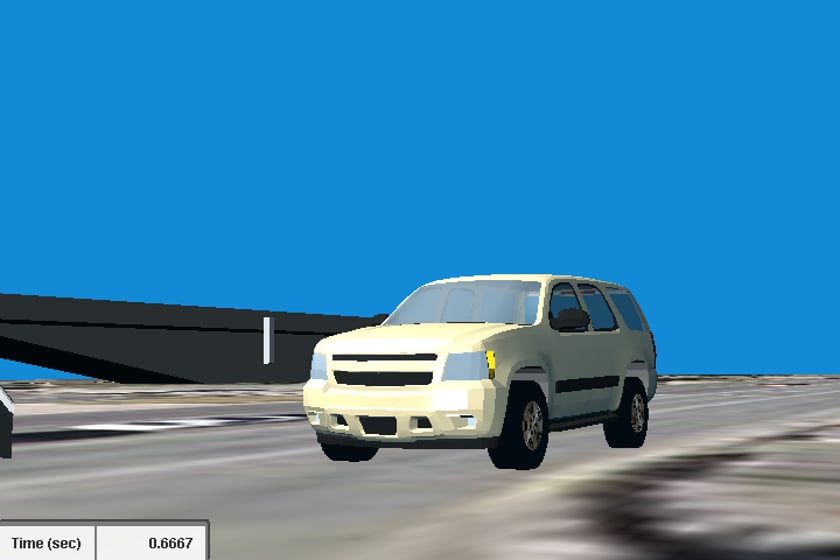
S-E-A Human Vehicle Environment (HVE) recreation of accident scenario
Assigned Task:
To perform the analysis, S-E-A took the following steps:
- Performed a damage pattern analysis.
- Performed inspections of the subject vehicles, including an attempt to download from the airbag control module (ACM). Because of the low speed involved in the incident, there was no event saved on the vehicle data systems (ACM).
- Modeled the incident scene in a simulation environment.
- Acquired models of the involved vehicles. Modified the trailer model to include the unique geometry introduced in this incident by a custom stake pocket that was present on the trailer.
- Performed simulations by virtually placing the vehicles in the scene to analyze the interaction between them, and determine the maneuver required by the truck to successfully make the turn.
Following the initial report, S-E-A was further asked to perform a vehicle-to-vehicle crash test to verify the simulation. To recreate the scenario, S-E-A:
- Acquired an exemplar SUV, tractor, and flatbed trailer.
- Modified the trailer by fabricating and installing the stake pocket with the same dimensions as that on the subject incident trailer.
- Instrumented the SUV with an accelerometer at the vehicle’s center of gravity. To document occupant exposure, an Anthropomorphic Test Dummy (ATD) was positioned in the front passenger seat to record acceleration and force data at the head, neck and lower back. A human volunteer was also positioned in the driver seat.
- Equipped numerous video cameras to capture all interaction between vehicles, as well as the kinematics of the ATD and human passenger during the test.
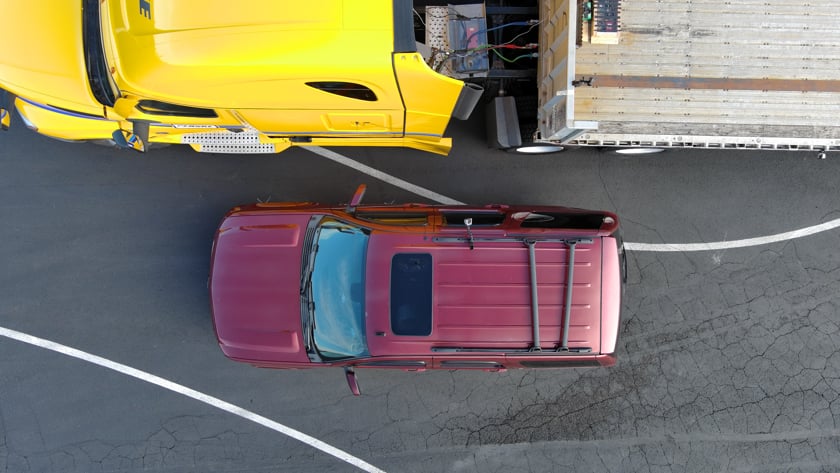
S-E-A drone footage of recreated accident scenario
- Programmed the S-E-A Automated Test Driver to drive the tractor-trailer along a repeatable turning path based on HVE simulated vehicle output data. The location of the SUV was informed by these trial runs and was placed along the turn path before the crash test. Sensors in the tractor and trailer provided speed, position, and acceleration data for both vehicles.
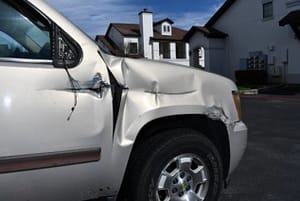
Damage to SUV in subject incident
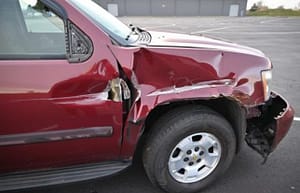
Damage to SUV in S-E-A crash test
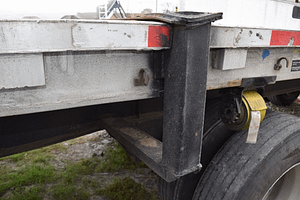
Damage to trailer in S-E-A crash test
Evidence was evaluated resulting in the following findings:
- The tractor was around 30 degrees into its 90-degree left turn when the contact between the trailer and SUV occurred.
- The SUV was not visible in the side mirrors of the tractor when the collision occurred.
- To successfully navigate the left turn, the truck driver was required to swing right before turning to prevent contact between his vehicle and the guardrail.
- The recorded accelerations and forces were comparable to tasks that are routinely undertaken in daily living. When compared to published exposure values in literature, the occupant accelerations in this test were determined to be well below injury thresholds.